West Point HVAC Air Stone HVACWest Point HVAC Air Stone HVAC

Hydronic Boiler Maintenance and Repair

Philadelphia contains one of the largest concentrations of hydronic heating systems in the country, spanning nineteenth-century brick rowhomes in Queen Village, Fishtown, and South Philadelphia to stone properties…
Call (267) 501-1824 →(267) 501-1824
Hydronic Boiler Maintenance and Repair in Philadelphia, PA
Quick answer
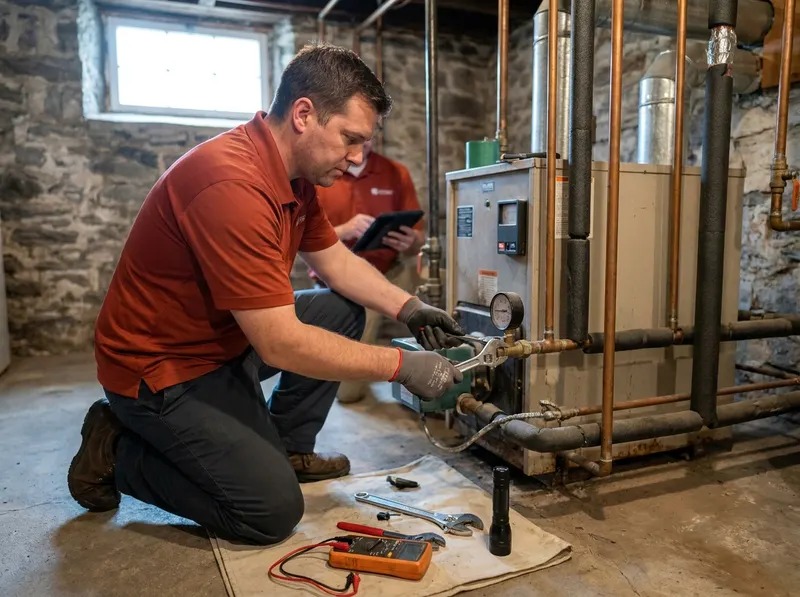
  • What is included: Comprehensive diagnostic assessment, burner cleaning, aquastat calibration, pressure relief valve verification, expansion tank inspection, circulator pump testing, and radiator zone bleeding.
  • Response window: Standard diagnostic appointments available weekly, with prompt mechanical dispatch for active heating failures during severe cold snaps across Philadelphia County.
  • Pricing baseline: Hands-on system evaluations start at the Philadelphia minimum of $250, with complete itemized pricing presented before repairs begin.
  • Equipment serviced: Natural gas, oil, and high-efficiency cast-iron hydronic boilers, baseboard fin-tube convectors, and standing cast-iron radiators.
  • How to schedule: Call (267) 501-1824 directly to speak with a technician and secure an on-site diagnostic visit.

Philadelphia contains one of the largest concentrations of hydronic heating systems in the country, spanning nineteenth-century brick rowhomes in Queen Village, Fishtown, and South Philadelphia to stone properties throughout Mount Airy and Chestnut Hill. Hydronic heating relies on water circulation rather than forced air, moving heated water through heavy cast-iron radiators or copper baseboards. When these systems fail, the issue is rarely a total boiler failure; it is frequently an airbound distribution pipe, a failed aquastat relay, a seized circulator pump, or an over-pressurized expansion tank that triggers the safety relief valve.

Choosing targeted maintenance and component repair over full system replacement preserves durable cast-iron boiler blocks that can operate reliably for decades. Converting an older hydronic system to forced air requires tearing open historic plaster walls to run bulky supply and return ductwork, which often costs three to four times more than rebuilding hydronic controls. While modern condensing boilers deliver high efficiency, maintaining an existing standard-efficiency boiler with fresh gaskets, cleaned pilot assemblies, and balanced water pressure delivers steady heat without massive upfront renovation expenses.

Navigating tight basement access points and aged plumbing manifolds is a standard reality in neighborhoods like Manayunk, Roxborough, Northern Liberties, Center City, and West Philadelphia. Mineral scale from local municipal water can restrict flow within auto-feed valves and heat exchanger passages over time, reducing overall heat output. Routine flushes, burner adjustments, and systematic radiator venting eliminate cold spots on upper floors while preventing sudden mid-winter boiler shutdowns.

What it costs

Hydronic boiler diagnostic & electrical safety check$250 - $350
Circulator pump replacement or flange rebuild$450 - $850
Expansion tank & pressure relief valve replacement$325 - $600
Multi-story radiator bleeding & hydronic loop balancing$250 - $475
Annual cast-iron boiler tune-up & burner cleaning$250 - $425

Every job gets a firm, written price after a free on-site visit.

Common questions

Why are the upstairs radiators cold while the boiler runs in my Philadelphia rowhome?
Trapped air within the upper piping loops or a weakened circulator pump usually prevents hot water from reaching higher floors in multi-story Philadelphia rowhomes. Purging air pockets from individual radiator bleed valves and checking system pressure at the boiler restores proper thermal distribution.
How often does a hydronic boiler need service in Philadelphia?
Hydronic boilers in Philadelphia should undergo a thorough safety inspection and mechanical servicing once every year prior to the start of the winter heating season. Annual service clears soot from the heat exchanger, checks the backflow preventer, and verifies that safety limit switches operate correctly.
What causes water to pool around a boiler in a Philadelphia basement?
Water pooling around a hydronic boiler in Philadelphia is typically caused by a leaking pressure relief valve, a failed expansion tank internal diaphragm, or worn circulator pump flange gaskets. A technician inspects the system to distinguish between minor external pipe fitting leaks and internal heat exchanger cracks.
Can older cast-iron hydronic boilers in Philadelphia be repaired instead of replaced?
Yes, older cast-iron boilers throughout Philadelphia can usually be repaired by swapping out modular components such as gas control valves, thermocouples, zone valves, or circulator pumps. Replacement is generally necessary only if the structural cast-iron sections have cracked and are leaking water directly into the combustion chamber.
What is the minimum cost to diagnose a hydronic boiler in Philadelphia?
Boiler evaluations in Philadelphia start at a $250 minimum diagnostic charge, which includes physical safety checks, electrical testing, and on-site diagnosis before any repairs are performed.

Ready to get started?

Tell us about your hydronic boiler maintenance and repair job in Philadelphia and we'll send a clear, written quote — usually the same day.